
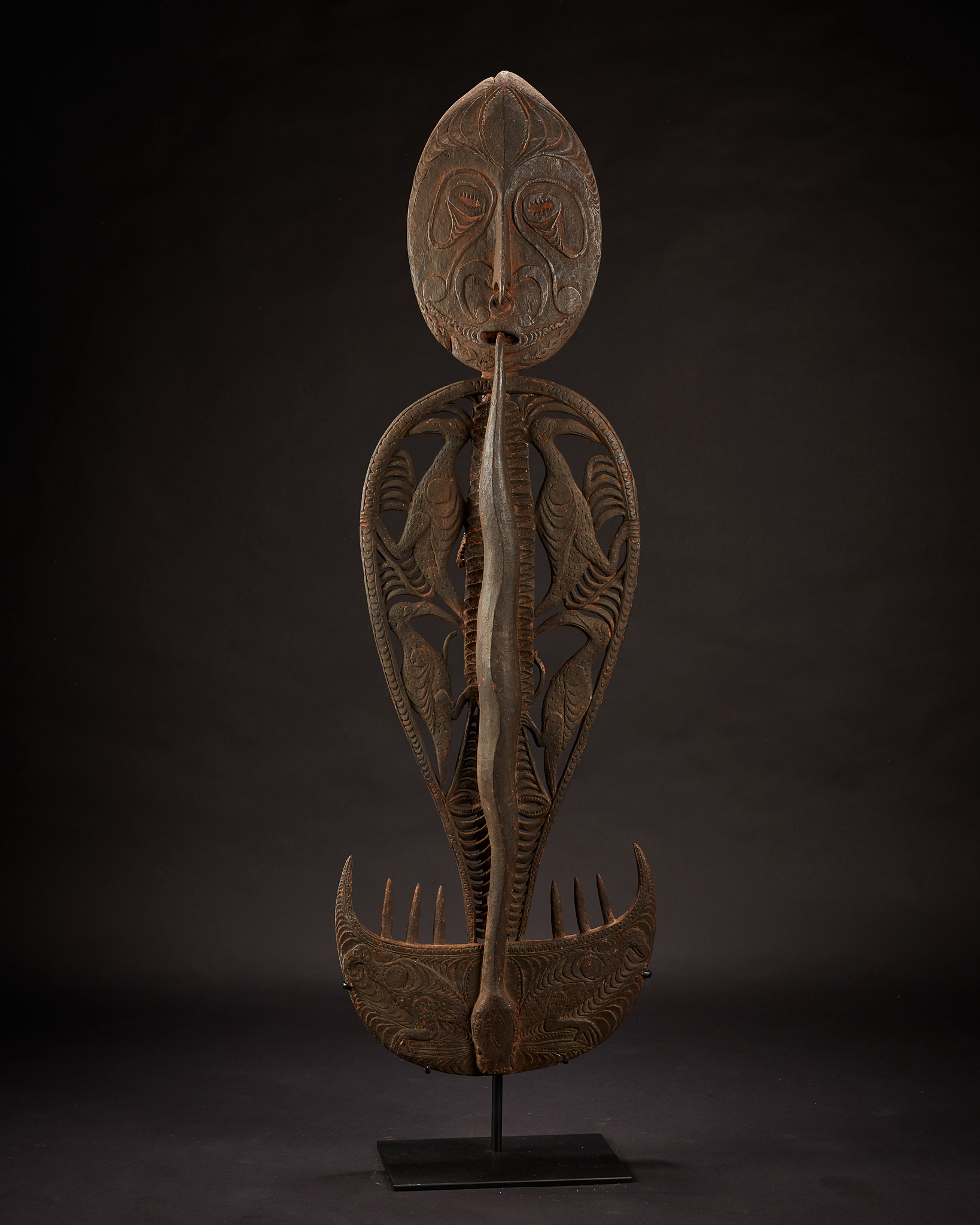
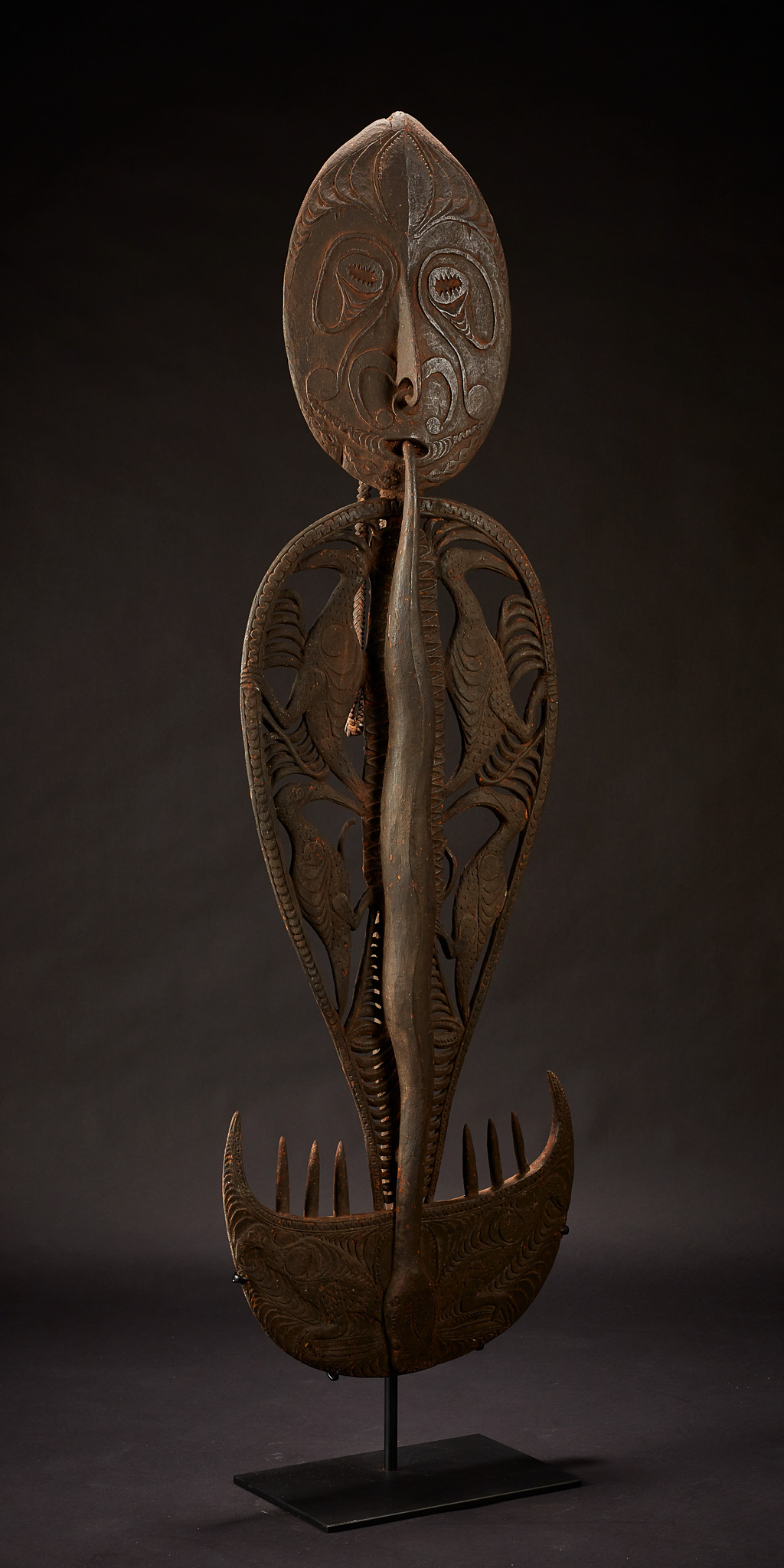

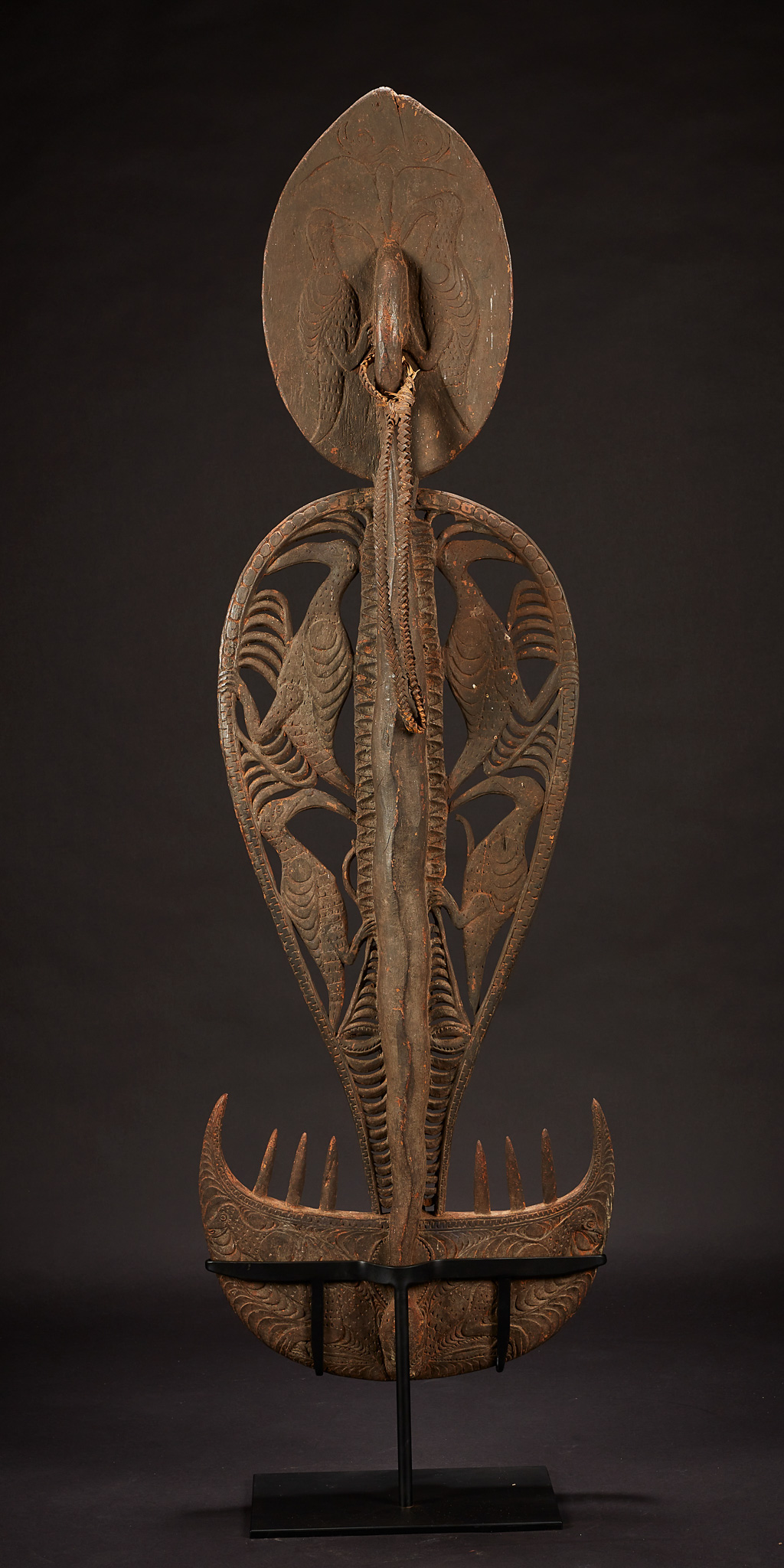


LARGE BASKET HOOK, samba, Kanganaman village
Chris Boylan Oceanic Art
Large Basket Hook, samban, Kanganaman village, Iatmul people, Middle Sepik, PNG
132 x 42 x 7
Collected by Robert Bunsing, a patrol officer stationed at Pagwi, Middle Sepik in mid-1960s.It came into possession of Senta Taft at Galleries Primtif, Sydney in the early 1970s, then into a private collection in rural NSW. The object has some minor restoration where broken at some time in the past, very professionally done.
Kanganaman village is renowned for the fine workmanship of their carved forms, particularly the carved basket hooks, called samban in the Iatmul language. This
Finely executed example represents an important accomplished work, distinguished by its assured carving, balanced proportions and refined surface detail. There is no doubt it was carved by an older master carver of Kanganamon and dates to the 1940s-early 1950s.
A large ancestral face, powerfully rendered, dominates the hook. Extending down the central axis, both front and back, is a long sinuous serpent motif. The serpents tail exits the mouth and undulates down the length of the form reinforcing the object’s strong verticality and finishes in a large, engraved head at the base, Serpents are deeply embedded in Iatmul cosmology, associated with ancestral power, transformation, and the life-giving forces of the Sepik River.
Both sides of the serpent are richly engraved with bird totem figures surrounded by curved fretwork. The crescent-shaped base is articulated by the two main hooks, elegantly curved upwards. In between are other hooks, or prongs, at fluis angles. These hooks hold baskets of food and woven bilums of other valuable items.
The seamless integration of symbolic imagery with utilitarian purpose exemplifies the Sepik River region’s profound union of art, ritual and daily life.
SOLD
Artwork details
Origin
unknown
Dimension
H 51.968532IN x W 18.503947IN x D 2.755907IN
H 132CM x W 47CM x D 7CM
Provenance
Collected by Robert Bunsing, a patrol officer stationed at Pagwi, Middle Sepik in mid-1960s.It came into possession of Senta Taft at Galleries Primtif, Sydney in the early 1970s, then into a private collection in rural NSW. The object has some minor restoration where broken at some time in the past, very professionally done.
Condition
GOOD. some minor restoration done many years ago, and very professionally