

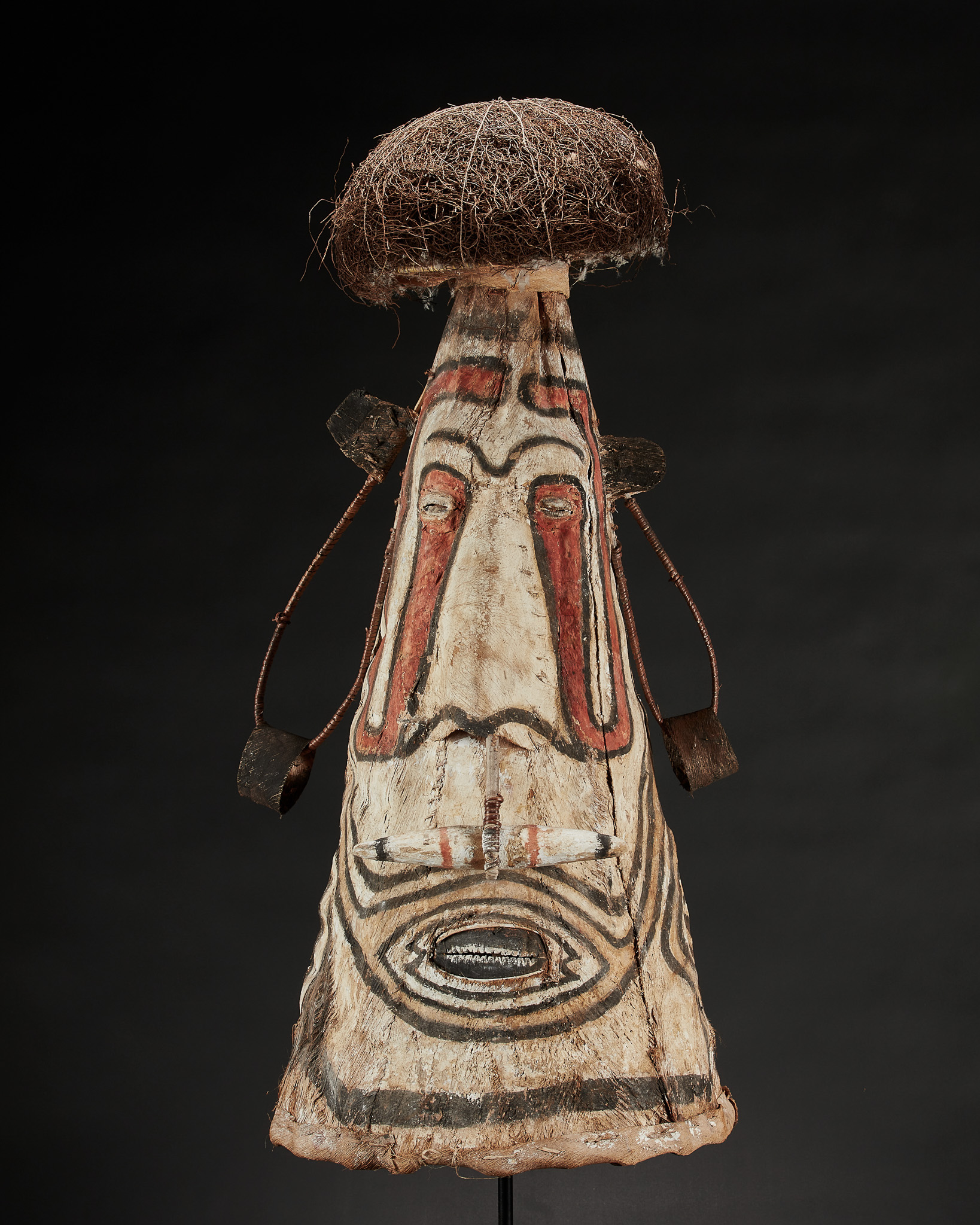
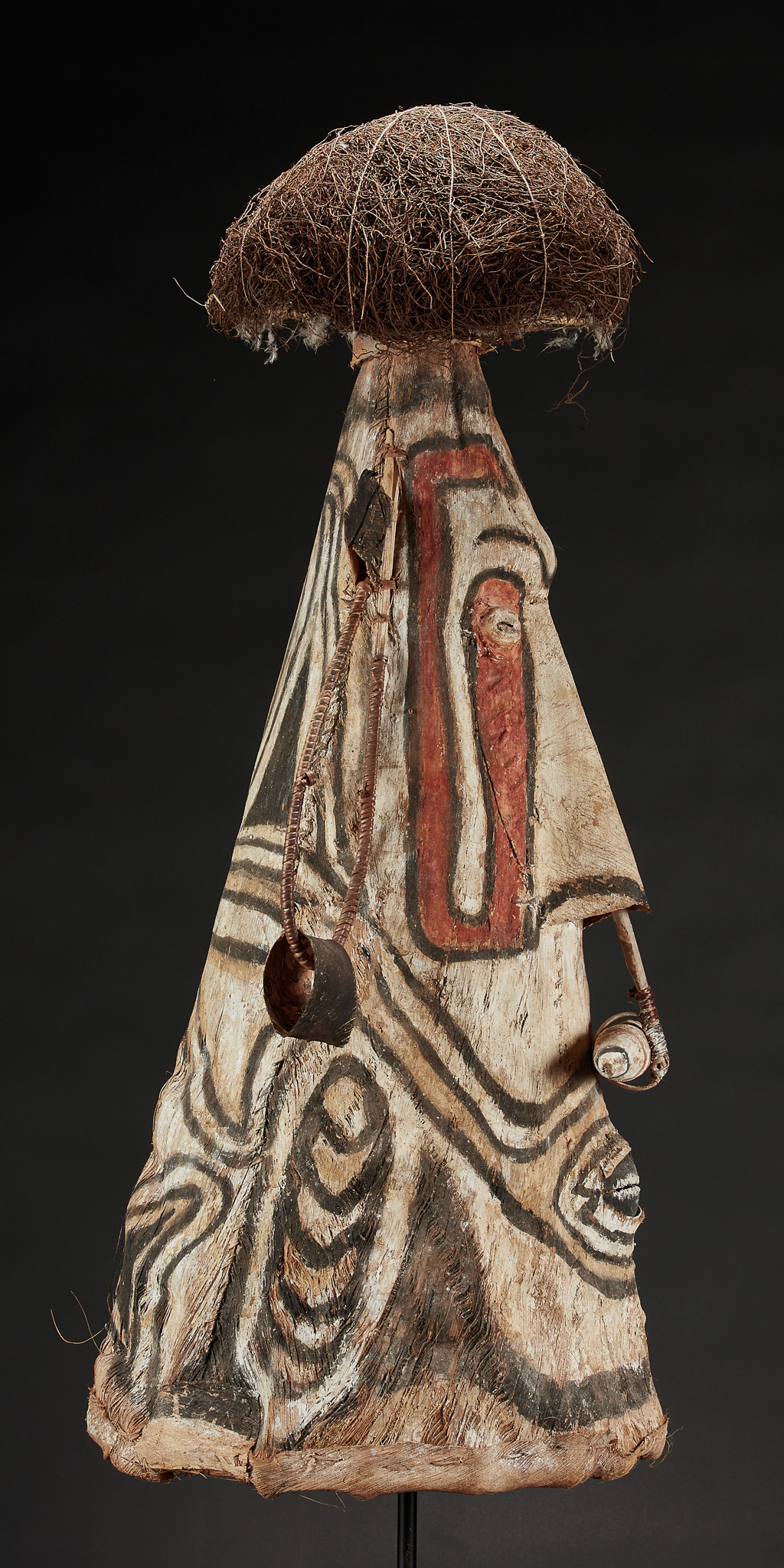
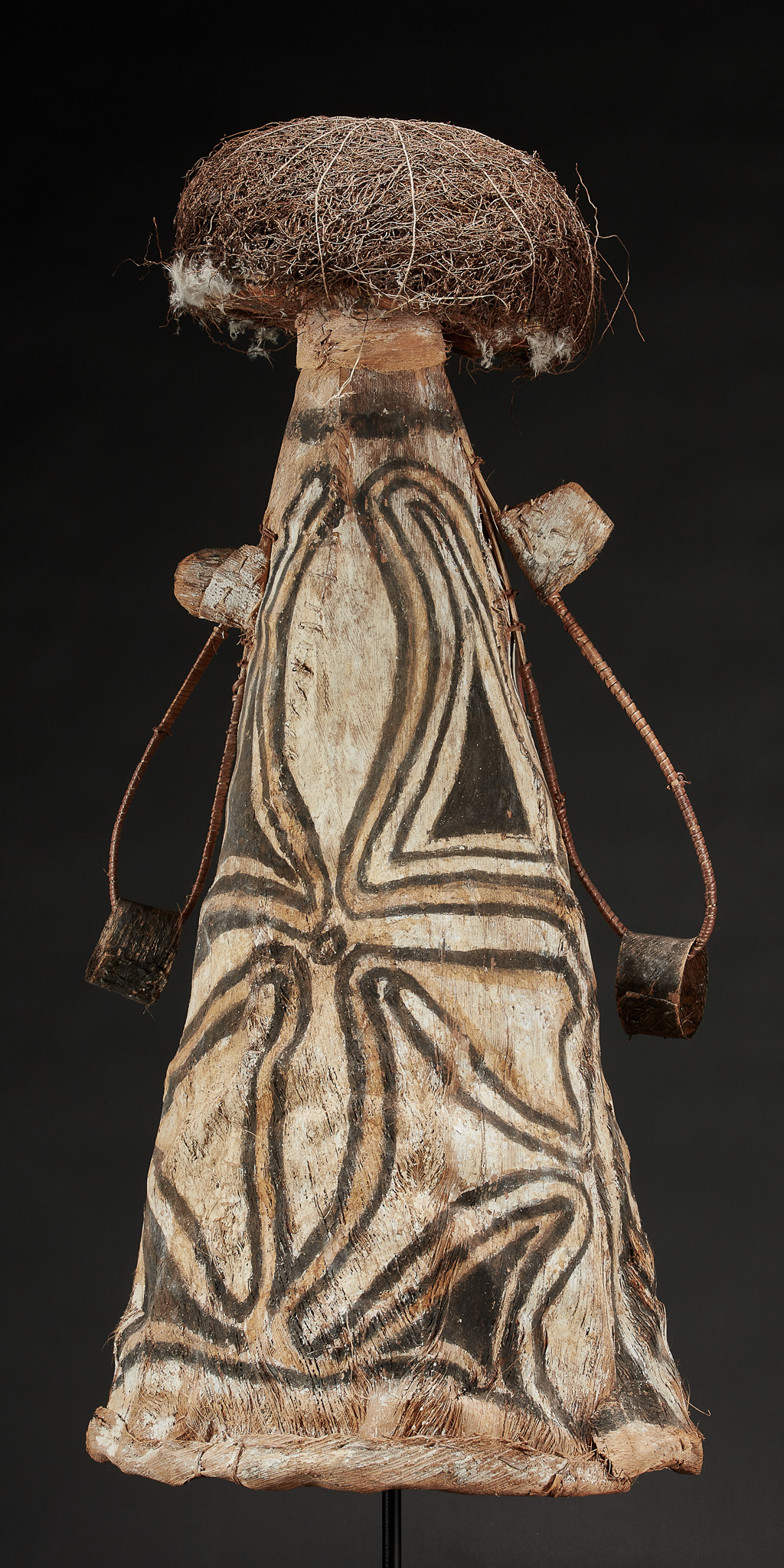
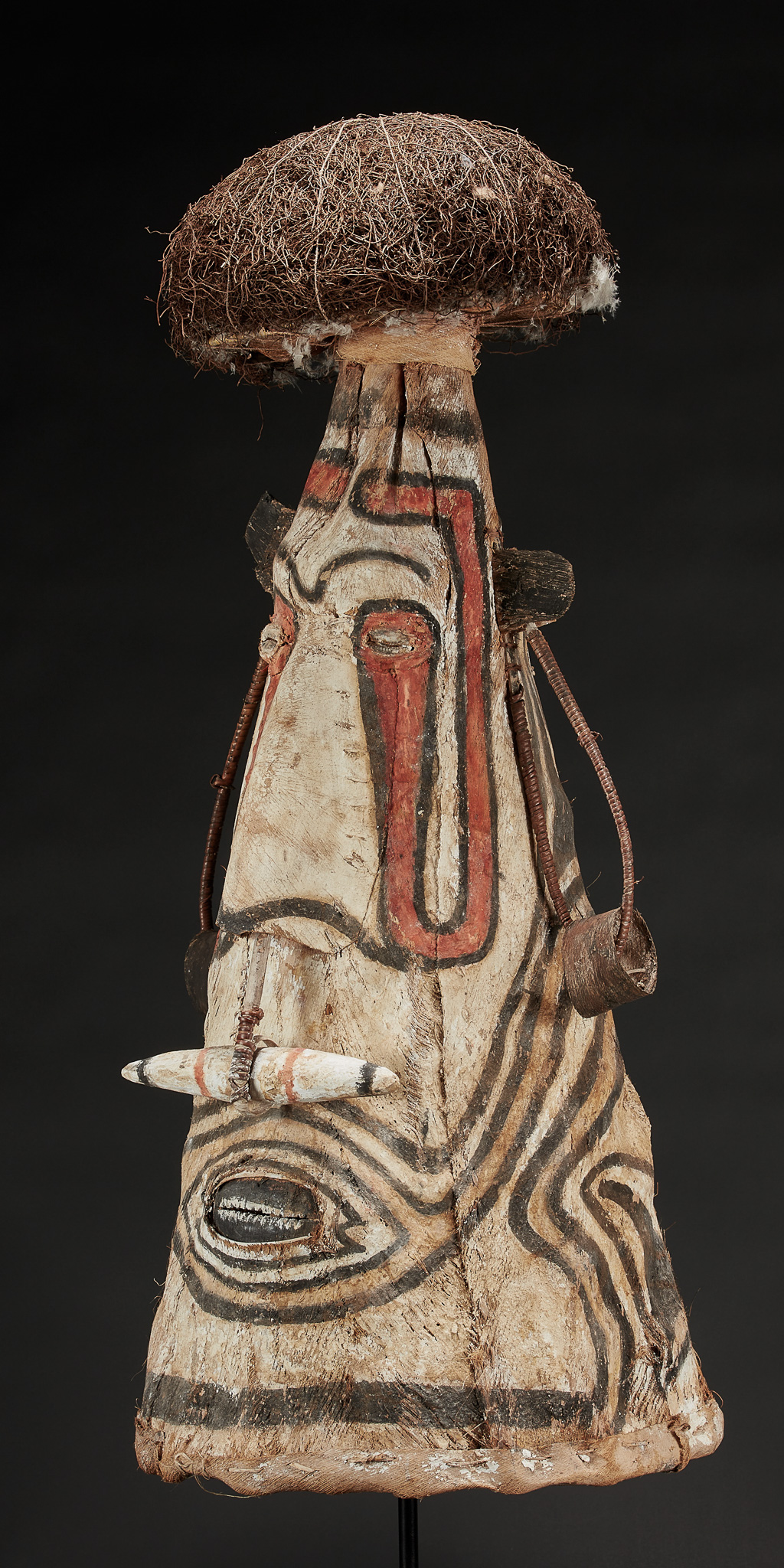
Tapa Dance Mask, Witu Islands
Chris Boylan Oceanic Art
Tapa Dance Mask, Witu Island, West New Britain, Papua New Guinea
88 x 32 cm diameter
From an important Tahitian collection, assembled in the 1970s.The collection includes a small group of related masks comprising both larger, masks known as mare, and smaller forms, known as namo-timbulu. This medium sized example is known as namo-ulu.
Large conical dance masks constitute a major sculptural tradition among the cultural groups of New Britain. Such masks are well documented among the Tolai and Sulka peoples. The witu islands, only accessible by a long sea journey from the New Britain mainland have maintained a particularly strong continuity of ceremonial practice.
Early German explorers referred to these tall conical masks as “funeral masks”. But subsequent research clarified that they are used in initiation ceremonies performed during rites of passage marking the transition of young men into adulthood.
The mask is constructed over a conical bamboo framework, tightly wrapped in tapa cloth. A pronounced projecting nose extends from the cone, the septum holding a large wood nose ornament. The face is further animated by large, looped ears, with fibre earrings, while the apex is crowned with a topknot to resemble a large coiffure.
The Germans collected quite a number of these imposing masks in expeditions between 1890-1905 and they are now housed in German museums. A key reference book is :”Form Colour Inspiration – Oceanic Art from New Britain”, by Ingrid Hermann, Arnoldsche 2001.
SOLD
Artwork details
Origin
unknown
Dimension
H 34.645688IN x DIA 12.598432IN
H 88CM x DIA 32CM
Provenance
Tapa Dance Mask, Witu Island, West New Britain, Papua New Guinea
88 x 32 cm diameter
From an important Tahitian collection, assembled in the 1970s.The collection includes a small group of related masks comprising both larger, masks known as mare, and smaller forms, known as namo-timbulu. This medium sized example is known as namo-ulu.
Large conical dance masks constitute a major sculptural tradition among the cultural groups of New Britain. Such masks are well documented among the Tolai and Sulka peoples. The witu islands, only accessible by a long sea journey from the New Britain mainland have maintained a particularly strong continuity of ceremonial practice.
Early German explorers referred to these tall conical masks as “funeral masks”. But subsequent research clarified that they are used in initiation ceremonies performed during rites of passage marking the transition of young men into adulthood.
The mask is constructed over a conical bamboo framework, tightly wrapped in tapa cloth. A pronounced projecting nose extends from the cone, the septum holding a large wood nose ornament. The face is further animated by large, looped ears, with fibre earrings, while the apex is crowned with a topknot to resemble a large coiffure.
The Germans collected quite a number of these imposing masks in expeditions between 1890-1905 and they are now housed in German museums. A key reference book is :”Form Colour Inspiration – Oceanic Art from New Britain”, by Ingrid Hermann, Arnoldsche 2001.
Condition
good